Home / Software
Every coefficient, five ways to run it

Software for inter-rater reliability analysis

Every chance-corrected agreement coefficient and intraclass correlation coefficient in the Handbook is implemented and ready to use — in a spreadsheet, in the browser, or in your language of choice.

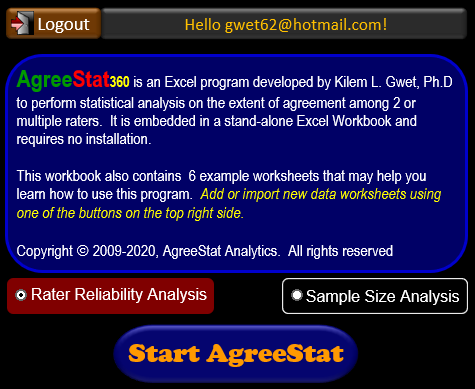
AgreeStat360 for Excel/Windows interface
01 · Desktop

AgreeStat360 for MS Excel / Windows

Point-and-click reliability analysis inside the spreadsheet your co-authors and reviewers already trust. No coding, no separate stats package — enter your ratings, pick a coefficient, and AgreeStat360 does the rest.

CAC coefficients
ICC coefficients
Cohen's Kappa
One-way random ANOVA ICC
Gwet's AC1 / AC2
Two-way random ANOVA ICC
Krippendorff's alpha
Two-way mixed ANOVA ICC
02 · Browser-based

AgreeStat360 / Cloud-Based

The same analysis, no install required. Two tools, both free to try from a browser tab.

Reliability analysis

AgreeStat360 / Cloud

Register for a free trial at agreestat360.com. Any paid AgreeStat360 license key also unlocks the Excel/Windows version — one license, both platforms.

Significance testing

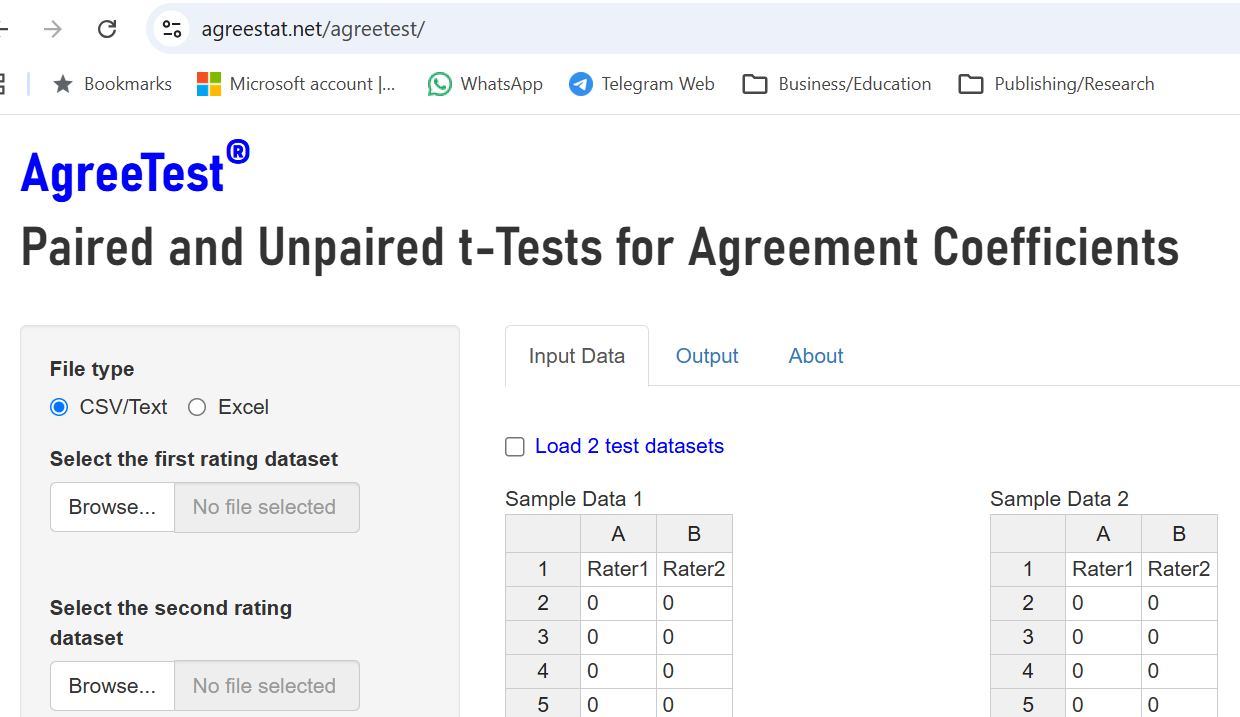
AgreeTest / Cloud

Test whether the difference between two agreement coefficients is statistically significant, entirely in the browser — no spreadsheet setup needed.

AgreeTest interface preview
03 · Open source

R packages & R functions

For researchers who want reliability analysis inside a reproducible script rather than a spreadsheet. AgreeStat maintains a set of R functions that compute the same chance-corrected agreement coefficients and intraclass correlation coefficients documented in the Handbook — built to match the book's formulas exactly, so a result in R and a result in AgreeStat360 will always agree.

Appendix B of the Handbook reviews the general-purpose R packages available for inter-rater reliability work and shows where AgreeStat's own functions fill in the gaps — particularly for Gwet's AC1/AC2 and for benchmarking coefficient magnitude.

R
EXAMPLE CALL
Gwet's AC1 on a rating matrix
# ratings: subjects x raters matrix
library(agreestatR)

result <- gwet_ac1(
  data = ratings,
  weights = "quadratic"
)

print(result$coefficient)
print(result$conf_interval)
SAS
EXAMPLE MACRO
Kappa with a custom weight matrix
* dataset RATINGS has one row per subject;
%agree_kappa(
  data = ratings,
  vars = rater1 rater2,
  weights = quadratic
);

* output: kappa, se, 95% CI;
04 · Enterprise / academic

Programs in SAS

SAS macros implementing the chance-corrected agreement coefficients and intraclass correlation coefficients covered in the Handbook, for research groups and government agencies standardized on SAS.

The macros accept the same rating-matrix or long-format datasets described in Chapter 2, and return the coefficient alongside its standard error and confidence interval — matching the statistical inference framework laid out in Chapter 6.

05 · Also available

Stata & Python

Community-built packages for teams standardized on Stata or Python, recommended alongside AgreeStat's own tools.

STA

KAPPAETC

A Stata module covering a wide range of agreement coefficients — including AC1, Kappa, and Krippendorff's alpha — with standard errors and confidence intervals, all installable from within Stata.

PY

irrCAC (Python)

A Python port of Dr. Gwet's chance-corrected agreement coefficients, maintained by Aris Fergadis on GitHub, for researchers who'd rather stay in a Python workflow than switch tools.